KEY TAKEWAYS
1. A Race Decided by Seconds
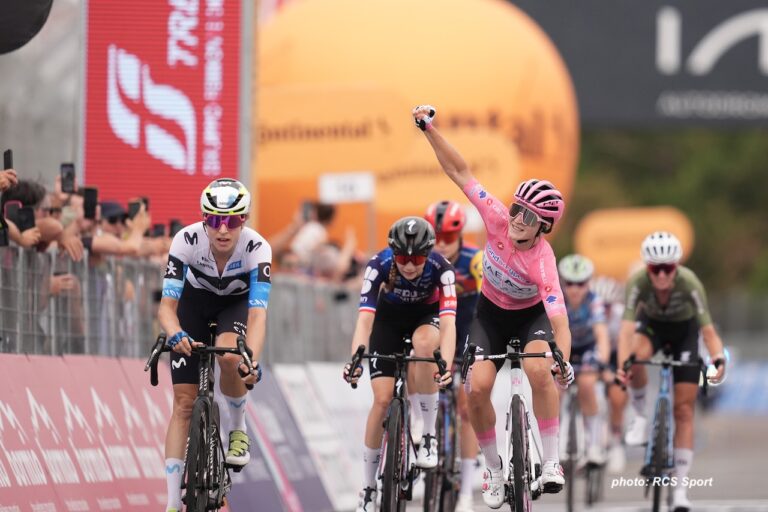
Elisa Longo Borghini emerged victorious, but only just. Her final margin over runner-up Marlen Reusser was a mere 18 seconds, marking one of the closest finishes in the history of the race. This slim gap wasn’t the result of a last-minute surprise but rather the culmination of 8 days of brutal racing where every bonus second mattered. Along with last year’s 21 second difference in the final GC between Longo Borghini and Kopecky, this ultra-tight result underscores the rising level of competition in the women’s peloton. Will we see this year’s Tour de France Femmes decided again by mere seconds?
2. The End of SD Worx-Protime’s GC Reign
Perhaps the most symbolic shift was the noticeable absence of dominance by SD Worx-Protime. Long regarded as the powerhouse of women’s cycling, the team struggled to assert its usual control over the race. While they remained active and tactically sharp, they failed to put a rider on the final GC podium. Kopecky suffered from pain in her back and went home early, and Anna van der Breggen struggled on the climbs, finishing sixth on GC at 3:32″. While the two wins by Lorena Wiebes would be considered a success by any other team, for SD Worx-Protime it shows a dramatic shift – downwards – in their performance. Whether it’s a sign of tactical miscalculations, roster transition, or the rest of the peloton simply catching up, one thing is clear: the era of near-automatic SD Worx-Protime supremacy is over.
3. Unrelenting Racing: Illness and Attrition Define the Giro
This year’s Giro wasn’t just a strategic battle; it was a war of attrition. Riders were consistently dropped on climbs that, on paper, weren’t expected to create large time gaps. The peloton splintered day after day under relentless pressure, suggesting a combination of factors: more aggressive team tactics, stronger individual performances, and perhaps an underlying element of illness. Several riders reportedly fell sick during the race, sparking questions about whether the intense racing itself pushed immune systems to the limit. It was a Giro defined not just by who was strongest, but by who could simply survive.
4. Sara Gigante is Back — And Better
After injuries and setbacks last year, Australian climber Sara Gigante announced her full return to the top tier with a commanding performance. Winning two mountain stages in solo fashion — distancing her GC rivals with explosive accelerations — Gigante didn’t just prove she was back; she proved she’s a serious Grand Tour contender. While Gigante showed some tactical errors when she lost 1:42″ on stage 4, a dead flat stage, she more than made up for any losses on the climbs. Watching her take forty-five seconds out of Elisa Longo Borghini in the final 3 kilometers of stage 7 was impressive. If she can improve on her tactics, and her time trialing, she could be a serious threat in future Grand Tours. At twenty-four, Gigante has plenty of time to learn and grow into becoming a GC contender.
5. Marlen Reusser: Stronger Than Ever
Though she narrowly missed out winning the overall GC, Marlen Reusser’s performance was nothing short of exceptional. Traditionally known for her prowess in time trials, Reusser’s climbing has taken a significant leap forward, allowing her to go toe-to-toe with the best GC riders in the mountains. Her consistency throughout the race — and her relentless drive in both time trials and hilly stages — marks her as a more complete rider than ever before. Her only weakness may be on the steep ramps of climbs where her size (1.80m/70 kilo) limits her ability to follow the punchy efforts of pure climbers. While she was able to follow Longo Borghini in stage 4 up the last climb (10.9km/7.4%), she lost thirty-two seconds in stage 7 on the final climb (14.8km/6.6%). Illness was a factor and probably hampered her efforts in going head-to head with Longo Borghini on the final climb in stage 7, but there still remains the question of whether she can follow the wheels of climbers like Demi Vollering. At this year’s Vuelta, Reusser lost time on Vollering on two climbs: stage 4 (24 seconds) and stage 7 (11 seconds). She’ll have to improve on climbs if she hopes to have a chance at taking the yellow jersey at Tour de France Femmes.
6. Experience Still Has Its Place
The 2025 Giro showed that experience still has its place when Elisa Longo Borghini and teammate Silvia Persico gapped Reusser on a descent in stage 7, then launched an attack up the 14km Monte Nerone climb to finish 32 seconds ahead of Reusser and claim the maglia rosa. Equally impressive was Anna van der Breggen’s gutsy riding in stage 8, where she attacked on the final descent after being momentarily distanced on the final climb. With only Liane Lippert able to stay on her wheel, Van der Breggen went full-gas to the line and reminded everyone why she’s still a threat to be reckoned with in the peloton. Both women demonstrated that older riders bring not only strength, but a deep understanding from years of experience of how to win – and sometimes that’s the difference between winning and losing.
RESULTS
Results powered by FirstCycling.com