The 123rd edition of Paris-Roubaix in 2026 will be remembered as the day Wout van Aert finally silenced the critics and conquered his personal demons on the cobbles of Northern France. The race began under a deceptive spring sun, but the pace from the depart fictif in Compiègne was anything but gentle. With a stiff tailwind blowing from the south, the peloton shattered the previous speed records, covering the first 100 kilometers at an eye-watering average of nearly 52 kilometers per hour. This “supersonic” start meant that no breakaway was allowed any significant leash, turning the run-in to the first sectors of pavé into a high-stakes bunch sprint for position that saw several mid-tier favorites caught in early crashes.
The real drama ignited at the Trouée d’Arenberg, the traditional graveyard of ambitions. As the leaders hit the jagged, moss-covered stones of the trench, disaster struck for the three-time defending champion Mathieu van der Poel. A freak double mechanical—shattering his rear derailleur and puncturing his front tire simultaneously—forced him to a standstill. While his teammates scrambled to provide a spare bike, the front of the race, led by a rampant UAE Team Emirates-XRG and Team Visma | Lease a Bike, sensed blood in the water. Van Aert, sensing the shift in momentum, moved to the front of the reduced elite group, setting a tempo that ensured the gap to Van der Poel would be measured in minutes rather than seconds.
However, the middle sectors of the race proved that luck is a fickle mistress in the Hell of the North. With 70 kilometers remaining, just as the lead group was thinning out, Van Aert suffered a rear-wheel puncture. In a display of cool-headed professionalism that had occasionally deserted him in previous years, he executed a rapid wheel change with his teammate Christophe Laporte and spent the next ten kilometers in a frantic, solo pursuit to regain the head of the race. He made contact just as the race reached the brutal five-star sector of Mons-en-Pévèle, where Tadej Pogačar launched the first of his trademark long-range grenades.
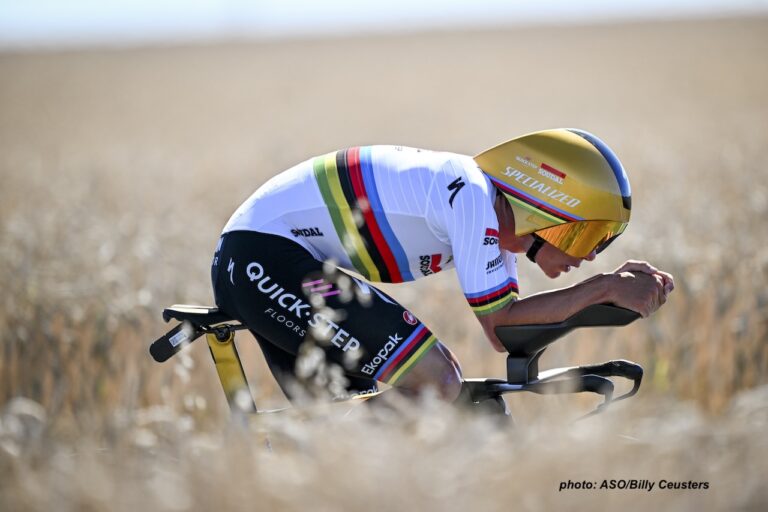
The final hour of the race transformed into a tactical chess match played at 50 kilometers per hour. Pogačar and Van Aert eventually found themselves alone at the front, a dream scenario for cycling fans but a nightmare for the Belgian, who knew the Slovenian’s penchant for late-race audacity. Pogačar’s strategy was clear: he needed to drop Van Aert on the stones to avoid a sprint finish. On the Carrefour de l’Arbre, the final major obstacle, Pogačar unleashed a series of violent, seated accelerations that looked set to snap the elastic. Van Aert’s bike skipped and bucked over the broken pavement, at one point losing traction entirely on a dusty corner, yet he gritted his teeth and closed every gap, refusing to yield a single inch to the World Champion.
Behind them, the race for the final podium spot was equally feral. Jasper Stuyven and a resilient Van der Poel—who had staged an incredible 40-kilometer solo chase to claw back into the top ten—were trading blows, but they could do nothing to stop the two titans at the front. As Van Aert and Pogačar crested the final rise toward Roubaix, the tension was suffocating. They entered the André-Pétrieux Velodrome as a duo, the silence of the crowd momentarily breaking into a deafening roar as they took the bell for the final lap.
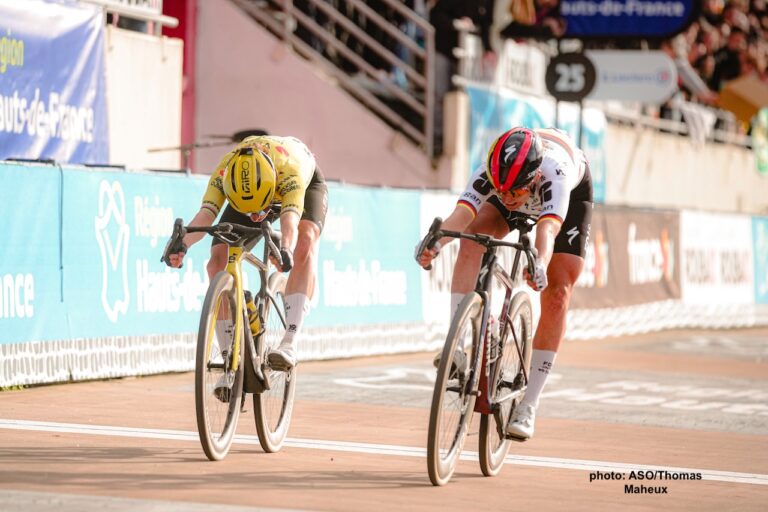
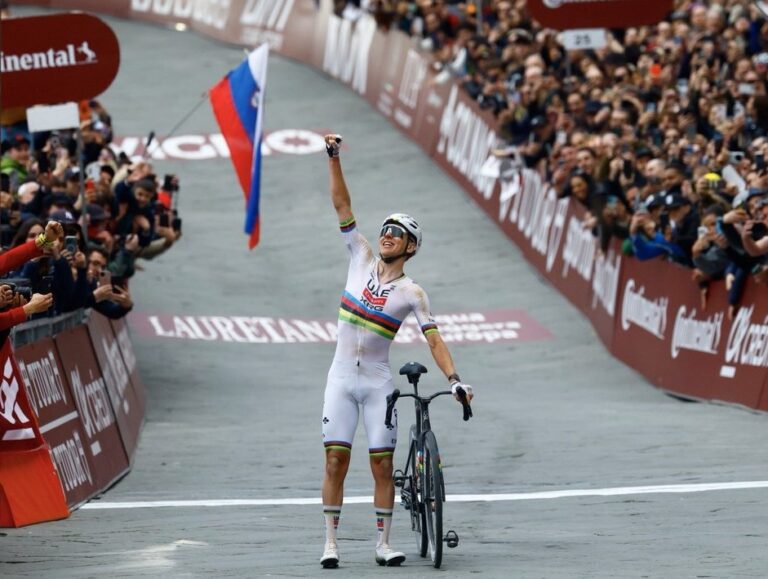
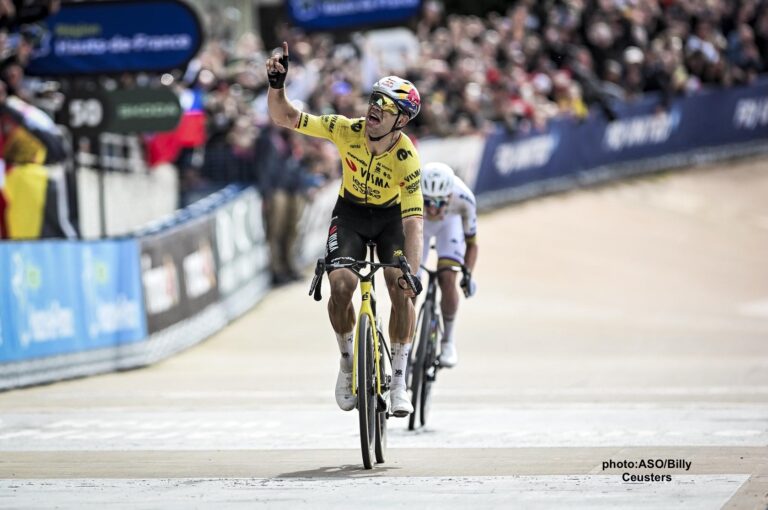
Pogačar led from the front, trying to use the banking to his advantage, but Van Aert played the sprint to perfection. Waiting until the final 150 meters, the Belgian launched a massive, high-torque acceleration that Pogačar simply could not answer. Van Aert crossed the line with his arms spread wide, eyes closed in a mixture of exhaustion and pure, unadulterated relief. This victory was more than just a trophy; it was the completion of a career-long quest, ending years of “what-ifs” and cementing his legacy as one of the greatest classics riders of the modern era.